Posts

Showing posts with the label trade secrets

CTC Legal's Second London IP Conference

Image
UK Supreme Court Author Kelsey Farish   Licence CC BY 4.0   Source Wikimedia Commons   Jane Lambert Last week's Winter Intellectual Property Conference  by CTC Legal Events was different from almost every  IP conference or seminar that I had previously attended.  For a start, there were very few slides.  I had prepared some for my talk on FRAND, as had  Maria-Christina Peyman of Birketts for her review of leading IP cases, but most of the topics were moderated discussions.  Secondly, the conference took place in  the magnificently equipped London campus of the University of Chicago's Booth School of Business .  Thirdly, the organizers attracted some of the biggest names in IP, such as Professor Sir Robin Jacob, a former Lord Justice of the Court of Appeal and Sam Williams, Head of Intellectual Property at Siemens.  A lot of information was squeezed into the 5th and 6th of November.  The organizers covered that grou...

WIPO Proof

Image
Standard YouTube Licence Jane Lambert A time-honoured way of proving the existence of a document on a particular day is to place it in a sealed envelope and post it to oneself or a trusted third party.  The envelope would bear a postmark proving the date and place of posting of the envelope.  If the seal was intact and there was no obvious tampering with the envelope it would prove that the ideas expressed in the document existed on the date of posting.  Often it proved other things such as the originator of the idea or at least the author of the document. In the United States, the exercise was called a "poor man's patent" possibly because it could sometimes identify the person who was entitled to apply for a patent before the Leahy-Smith America Invents Act (Public Law 112-29 26 Sept 2011) .  However, it was and is used here to prove the authorship of a copyright work or the originator of a trade secret.  The system of source code escrow is simply a...

WIPO Symposium on Trade Secrets and Innovation

Image
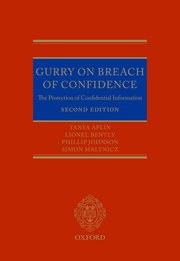
Jane Lambert Before he began his distinguished career in the WIPO, Francis Gurry  was best known for a rather good book on the law of confidence .  It is now in its second edition having been updated and edited by Tanya Aplin, Lionel Bently, Phillip Johnson, and Simon Malynicz. Although the law of confidence can be used to prevent unauthorized use or disclosure of any kind of secret information, it is the legal mechanism by which trade secrets are protected in the United Kingdom.  It is probably the most widely used means of protecting investment in innovation and creativity in this and other common law countries. The law of confidence offers a number of advantages over patents and other registered rights.  It is free. It arises whenever information the use or disclosure of which would benefit the confidant or harm the confider is imparted in circumstances that give rise to an obligation of confidence. It cannot be revoked as a patent can and t...

Pharma & Biotech Patent Litigation

Image
Jane Lambert For the second year running, I have been invited to address C5's annual conference on Pharma & Biotech Litigation .  That conference will take place at the Radisson Blu Hotel in Amsterdam between 26 and 27 Feb 2019.  Last year I discussed the Supreme Court's decision in  Eli Lilly v Actavis UK Ltd and others   [2017] Bus LR 1731, [2017] UKSC 48, [2017] RPC 21 with partners from the Dutch and German offices of DLA.  This year I shall be sharing a platform with  Anna P. López Lozano  who is head of IP at Esteve in Barcelona on the topic of Maximizing IP Regulatory Rights.  I shall be talking about supplementary protection certificates, a topic that I have recently addressed in the context of Brexit in Patents of there is no Deal   3 Oct 2018 NIPC Brexit. Brexit is one of the key themes of the 2019 conference and there be a pre-conference workshop on the topic on 25 Feb 2019 entitled READY, STEADY, BREXIT...

Can you keep a Secret? Non-Disclosure Agreements, Trade Secrets, Use, Abuse and the New Law

Image
Author : Willh26 Licence   Creative Commons  Attribution Share Alike 4.0 International Source Wikipedia Jane Lambert A recent decision of the Court of Appeal to enforce a non-disclosure agreement ("NDA") by means of an interim injunction has led to a promise by the Prime Minister to review the law relating to such agreements (see Court stops Telegraph publishing 'sexual harassment' story   24 Oct 2018 BBC website). While NDAs,  like any legal instrument can be abused, they are a very useful business tool.   They enable inventors to discuss their inventions with potential collaborators and investors before they are ready to apply for patents.  They prevent the disclosure or use of sensitive commercial information that may have taken years to gather.  They allow business relations to continue between parties to potentially damaging disputes. Earlier this year the trade secrecy laws of the 28 member states of the Euro...

Checking your Confidentiality Clauses and Agreements for Compliance with the Trade Secrets Directive

Image
Jane Lambert On 9 June 2018 the Trade Secrets Directive  was implemented into English and Welsh, Scottish and Northern Irish law by The Trade Secrets (Enforcement etc) Regulations 2018 . I discussed the directive's provisions in The Trade Secrets Directive   7 July 2016 NIPC Law and its implementation in  Transposing the Trade Secrets Directive into English Law: The Trade Secrets (Enforcement etc) Regulations   6 June 2018. I also advised that Trade Secrecy Law changes Tomorrow - check your NDA, Standard Terms and other Agreements   8 June 2018 NIPC Inventors Club. In this article I consider the checks that business owners and professional advisers should make to ensure that their contract terms comply with the new law. References to Confidentiality Agreements in the Directive The Trade Secrets Directive makes only two references to confidentiality agreements.   Art 4 (3) (b) lists "being in breach of a confidentiality agreement" as ...

The Trade Secrets (Enforcement, etc.) Regulations 2018 Consultation

Image
Jane Lambert As I noted in The Trade Secrets Directive 7 July 2016 NIPC Law, Directive (EU) 2016/943 of the European Parliament and of the Council of 8 June 2016 on the protection of undisclosed know-how and business information (trade secrets) against their unlawful acquisition, use and disclosure has to be transposed into national law by 9 June 2018. The Intellectual Property Office has published draft regulations that appear in Annex A of a consultation document on draft regulations concerning draft secrets.  These regulations are likely ti be called "The Trade Secrets (Enforcement, etc.) Regulations 2018." A news story dated 19 Feb 2018 explains that the government is canvassing views on those draft regulations and has posed the following questions: "Q1. Do you agree that regulations 2 and 3 implement effectively the definitions in the Directive? Q2. What are your views on the rules set out in regulations 4 – 9? Q3. Do you agree t...

IPR Helpdesk: Case Study on IP Strategy

Image
Author Rob984 Licence Creative Commons Attribution-Share Alike 4.0 International Source Wikipedia Jane Lambert Last week I answered the following question from Will Roebuck , one of my readers: "What do start-up entrepreneurs need to look for in a good IP lawyer?"  I replied: "Probably the most useful professional adviser will be one who can help you to use IP to meet your business objectives. That is known as " IP strategy" which the American lawyer Jackie Hutter described as the combination of business acumen with IP knowledge to provide business focused advice (see Hutter What is an IP Strategist? IP Asset Maximizer Blog)." My article elicited a number of comments including this one from Julian Potter of WP Thomson: "hi Jane, I am interested in the idea that IP strategists are a new type of adviser. It is certainly the case that in recent years one has seen a number of individuals and organisations refers to themse...

IP and Hair and Beauty

Image
L'Academie de Coiffure French satirical print from the 18th century Source Wikipedia Jane Lambert I found rather more materials on IP and hair and beauty industry than I had expected when I started to read the trade literature.  Sabrina Tozzi and Rachel Boakes of Baker & McKenzie LLP have contributed  IP and the beauty industry: cosmetic concerns? to Issue 50 of  IP Pro Life Sciences (12 Aug 2015).  Elaine Eggington of IP Pragmatics Ltd, has posted an interesting presentation entitled  Innovation in the cosmetics industry   to her company's website. There are also articles about free wifi with its implications for copyright and data protection in a discussion on free wifi in the Legal Lifeline section of the National Hairdressers Federation website.There are links to the PRS for Music  and Phonographic Performance Limited websites on the Hair Council links page . All of this suggests a wider than avera...

IP and Agriculture in the UK

Image
Combine Harvester Author Brian Forbes Source Wikipedi a  Creative Commons  Licence Jane Lambert According to the  Department for Environment, Food and Rural Affairs (" DEFRA" ) , some 476,000 individuals in the UK were employed or engaged in agriculture contributing £9.9 billion to the country's gross value added in 2014 (see  Agriculture in the United Kingdom 2014   DEFRA and devolved administrations). Branding As most consumers purchase their food from intermediaries there are limited opportunities for farmers who supply those intermediaries to distinguish their produce from those of their competitors. The position is, of course, different if they market directly to the public through their own farm shops or other retail outlets that they control or influence. If they can build up reputation or goodwill it makes sense to register the name, logo or other sign by which they are identified in the market as a UK trade mark. If...

How the Law protects Investment in Technology

I presented the final talk in my introduction to IP on Wednesday.  Like the Introduction  and the talks on  Branding and Creative Output  I focussed on the different ways the law can protect investment in an intellectual asset. Until recently technology was connected with manufacturing which probably explains why patents protect new products and processes. The European Patent Convention , which is celebrating its 40th anniversary this year, specifically excludes from the definition of patentable inventions programs for computers, methods of doing business and the presentation of information. Yet much of the British economy is now based on those activities.   For that reason I discussed not simply patents and trade secrets but also the different legal tools for protecting investment in software, data analysis, web 2.0 services and so on such as copyright, database right, design right and plant breeders' rights. You will find my slides here: : How the...

Autumn Talks - Introduction to Branding, Copyright and Related Rights, Patent Law and More

Image
Gray's Inn Square Source Wikipedia Building on our Introduction to IP  seminar on the 26 June 2013 we are holding workshops on: Branding Law  - that is to say trade marks, passing off, geographical indications, domain names on 25 Sept 2013; Creative Output - that is to say copyrights, rights in performances, moral rights and related rights on 30 Oct 2013; and Technology Law - patents, trade secrets, unregistered designs rights (including semiconductor topographies) and plant varieties on 27 Nov 2013. Each of these workshops will last 90 minutes plus breaks on the last Wednesday of each month between 16:00 and 18:00.   If you attend, you will qualify for CPD points from the SRA or BSB.   These talks will lay a foundation for more advanced workshops on the substantive law, licensing and litigation.   Best of all they will provide an opportunity to meet out new IP, technology and media law team who will attend as many of the talks a...