Posts

Showing posts with the label confidence

WIPO Symposium on Trade Secrets and Innovation
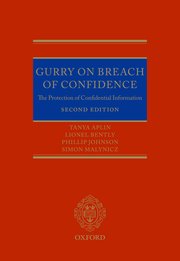
Image
Jane Lambert Before he began his distinguished career in the WIPO, Francis Gurry  was best known for a rather good book on the law of confidence .  It is now in its second edition having been updated and edited by Tanya Aplin, Lionel Bently, Phillip Johnson, and Simon Malynicz. Although the law of confidence can be used to prevent unauthorized use or disclosure of any kind of secret information, it is the legal mechanism by which trade secrets are protected in the United Kingdom.  It is probably the most widely used means of protecting investment in innovation and creativity in this and other common law countries. The law of confidence offers a number of advantages over patents and other registered rights.  It is free. It arises whenever information the use or disclosure of which would benefit the confidant or harm the confider is imparted in circumstances that give rise to an obligation of confidence. It cannot be revoked as a patent can and t...


Cambridge IP Law Summer School 2019

Image
Downing College Cambridge Jane Lambert Last week I was invited back to Cambridge by Knect365 to speak to the Cambridge IP Law Summer School  at Downing College. I was asked to repeat the talk on IP disputes and bilateral investment treaties that I gave to the 2017 summer school  and to mention the research on IP enforcement in the digital environment that Professor Frederick Mostert and I had carried out for the Advisory Committee on Enforcement of the WIPO (see Mostert and Lambert  Study on Intellectual Property Enforcement Measures, Especially Anti-piracy Measures in the Digital Environment – Executive Summary   and the full report) . I also chaired the final day's session on "Contentious IP". As in 2017, this year's course took place in Downing College's  Howard Building .  That building consists of a ground floor common room with a licensed bar and an auditorium on the floor above.  Morning coffee, afternoon tea and some ...

The Trade Secrets (Enforcement, etc.) Regulations 2018 Consultation

Image
Jane Lambert As I noted in The Trade Secrets Directive 7 July 2016 NIPC Law, Directive (EU) 2016/943 of the European Parliament and of the Council of 8 June 2016 on the protection of undisclosed know-how and business information (trade secrets) against their unlawful acquisition, use and disclosure has to be transposed into national law by 9 June 2018. The Intellectual Property Office has published draft regulations that appear in Annex A of a consultation document on draft regulations concerning draft secrets.  These regulations are likely ti be called "The Trade Secrets (Enforcement, etc.) Regulations 2018." A news story dated 19 Feb 2018 explains that the government is canvassing views on those draft regulations and has posed the following questions: "Q1. Do you agree that regulations 2 and 3 implement effectively the definitions in the Directive? Q2. What are your views on the rules set out in regulations 4 – 9? Q3. Do you agree t...

Five Pernicious Intellectual Property Myths

Image
Jane Lambert In this article, I am challenging the following myths that are probably responsible for our trailing many of our competitors in the number of patent, design and trade mark applications. Myth #1  There's no point in acquiring an intellectual property right because you can never afford to enforce it. It is probably still the case that England and Wales (and indeed Scotland and Northern Ireland) are among the most expensive countries in the world to bring a full blown patent action.  That is because our legal system provides for close investigation of the evidence and full consideration of the arguments which tends to assure the most just outcome. But most IP cases do not require that degree of scrutiny. For the last 6 ½ years the Intellectual Property Enterprise Court (formerly the Patents County Court) has provided a high-quality dispute resolution service where the issues are defined in advance, trials are limited to two days and recoverab...

IP and Hair and Beauty

Image
L'Academie de Coiffure French satirical print from the 18th century Source Wikipedia Jane Lambert I found rather more materials on IP and hair and beauty industry than I had expected when I started to read the trade literature.  Sabrina Tozzi and Rachel Boakes of Baker & McKenzie LLP have contributed  IP and the beauty industry: cosmetic concerns? to Issue 50 of  IP Pro Life Sciences (12 Aug 2015).  Elaine Eggington of IP Pragmatics Ltd, has posted an interesting presentation entitled  Innovation in the cosmetics industry   to her company's website. There are also articles about free wifi with its implications for copyright and data protection in a discussion on free wifi in the Legal Lifeline section of the National Hairdressers Federation website.There are links to the PRS for Music  and Phonographic Performance Limited websites on the Hair Council links page . All of this suggests a wider than avera...

What an employee can and cannot do when no longer on your payroll

Image
Jane Lambert While an employee remains on your payroll he or she is bound by an implied obligation of good faith and fidelity to do his or her best for you. He or she is not allowed to discuss your affairs in public or work for a competitor. As Mr Justice Laddie said in Ocular Sciences Ltd v Aspect Vision Care Ltd (No.2)  [1997] RPC 289, [1996] EWHC Patents 1, (1997) 20(3) IPD 20022, that has nothing to do with the law of confidence or trade secrecy. However, the employee is not your slave. He or she is entitled to seek work elsewhere or even set himself or herself up in business in competition with you. If the employee leaves your employment he or she is likely to use skills, knowledge and experience gained in your employment. There is nothing wrong with that even if you have spent time and money training the employee. After all, you see nothing wring in recruiting someone who has been trained by somebody else do you. Nor is it disloyal of the employee to atten...

Autumn Talks - Introduction to Branding, Copyright and Related Rights, Patent Law and More

Image
Gray's Inn Square Source Wikipedia Building on our Introduction to IP  seminar on the 26 June 2013 we are holding workshops on: Branding Law  - that is to say trade marks, passing off, geographical indications, domain names on 25 Sept 2013; Creative Output - that is to say copyrights, rights in performances, moral rights and related rights on 30 Oct 2013; and Technology Law - patents, trade secrets, unregistered designs rights (including semiconductor topographies) and plant varieties on 27 Nov 2013. Each of these workshops will last 90 minutes plus breaks on the last Wednesday of each month between 16:00 and 18:00.   If you attend, you will qualify for CPD points from the SRA or BSB.   These talks will lay a foundation for more advanced workshops on the substantive law, licensing and litigation.   Best of all they will provide an opportunity to meet out new IP, technology and media law team who will attend as many of the talks a...